Exploring the intersection of robotics, technology, and spiritual wisdom. Currently pursuing post-graduation at IIT Gandhinagar with a focus on manipulation and grasping in robotics.
Welcome to my website — a place where technology meets tradition. I'm Samriddhi Dubey, a passionate explorer in the world of robotics from Deori, a serene town in the Sagar district of Madhya Pradesh.
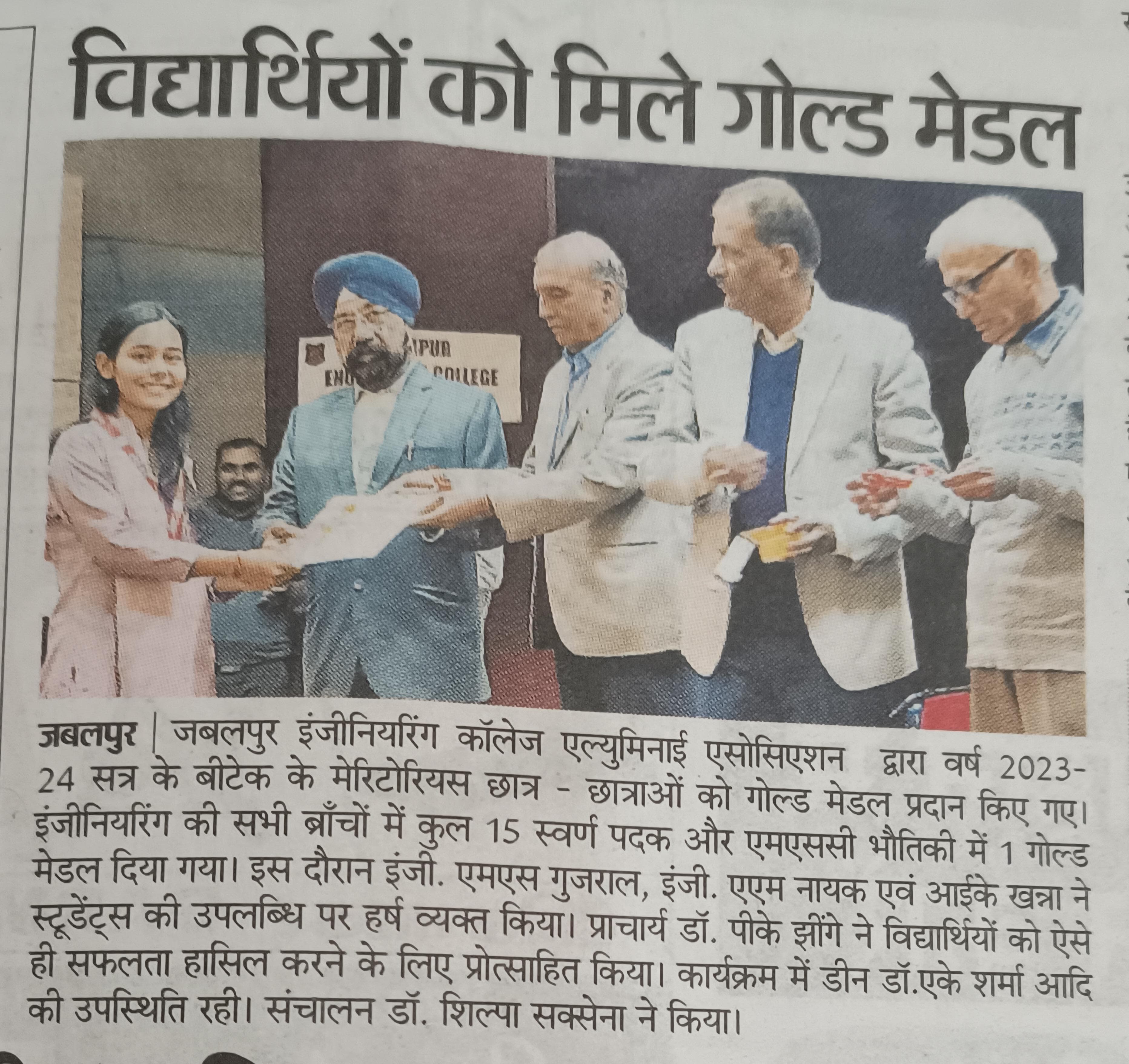
I come from Deori, a serene town in the Sagar district of Madhya Pradesh, and completed my schooling at Noble Public School. I earned my B.Tech from Jabalpur Engineering College as the Gold Medalist in Mechanical Engineering, and under an exchange program, completed my final semester at IIT Indore, which further deepened my curiosity and commitment toward advanced robotics research.
During my undergraduate studies, I developed expertise in mechanical systems analysis, particularly focusing on axial piston pumps and fault diagnosis. I worked extensively with MATLAB Simulink to create simulation models for analyzing leakage faults and pressure fluctuations in hydraulic systems. With time, my interest gradually shifted toward robotics, which became my primary focus for advanced studies.
My primary research interest now lies in manipulation and grasping, where I am currently working on implementing object impedance and object admittance controllers to enhance robotic interaction with unstructured environments.
Beyond the circuits and code, I have a profound interest in spiritual knowledge, drawing immense inspiration from the Bhagavad Gita, Shrimad Bhagavatam, and other timeless Indian scriptures.
This website is a reflection of both my technical journey and spiritual inclinations. Whether you're here to explore robotics, read about my projects, or connect over shared interests — I'm grateful you stopped by.
Gold Medalist in Mechanical Engineering from Jabalpur Engineering College, with a journey spanning from academic excellence to advanced robotics research.
My academic journey has been marked by continuous growth and achievement, from early recognition as a top student to specialized research in robotics at premier institutions.
My journey from school to advanced research has been shaped by key milestones that reflect my commitment to excellence in engineering and robotics.
Recognized for academic excellence and leadership qualities
Played nationals in throwball in clsas 10
Began B.Tech in Mechanical Engineering with focus on system dynamics
Completed final semester under exchange program, expanding research horizons
Graduated as Gold Medalist in Mechanical Engineering
Pursuing advanced research in robotics with focus on manipulation and grasping
Building on my academic achievements and research experience, I aim to contribute to the field of robotics through innovative solutions for real-world challenges, particularly in manipulation and grasping technologies that can enhance human-robot interaction and industrial automation.
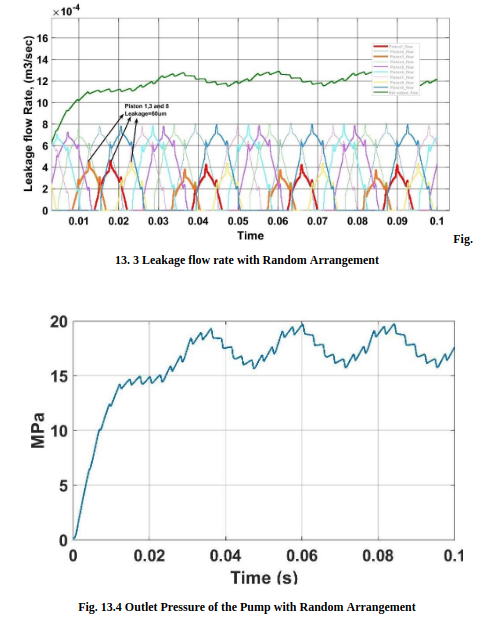
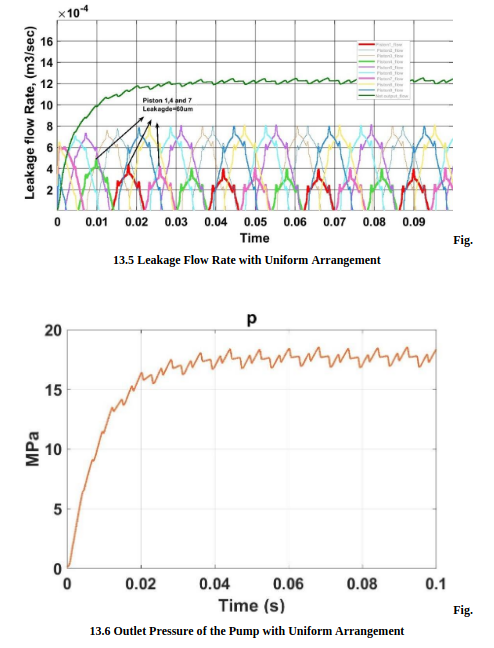
Discovered that uniform piston arrangement produces the least pressure fluctuation in faulty systems, providing a novel approach to fault management in axial piston pumps.
This project was carried out during my final year of BTech at IIT Indore under the guidance of Prof. Pavan Kumar Kankar in the Department of Mechanical Engineering. It focuses on the detailed analysis of failure modes in axial piston pumps (APPs), which are commonly used in industrial systems, automotive applications, and manufacturing setups. Despite their efficiency, these pumps face significant performance challenges due to internal leakage and pressure instability.
The core of the work involved developing a simulation model using the SIMSCAPE environment in MATLAB Simulink. A closed-loop variable displacement axial piston pump was modeled, accounting for the clearance between the piston and the cylinder block.
Created a detailed model in MATLAB Simulink with variable clearance parameters
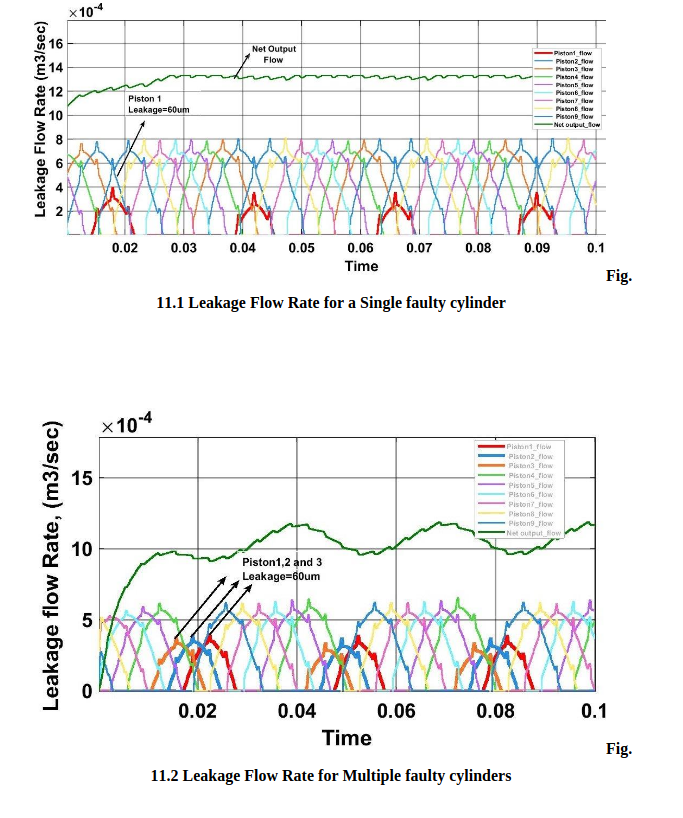
Simulated leakage faults by varying annular clearance from 1µm to 100µm
Compared results with experimental data from a Vickers PVB5 pump
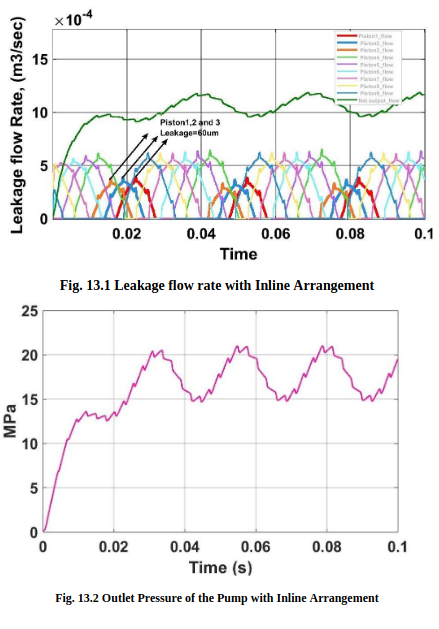
Analyzed inline, random, and uniform configurations for optimal performance
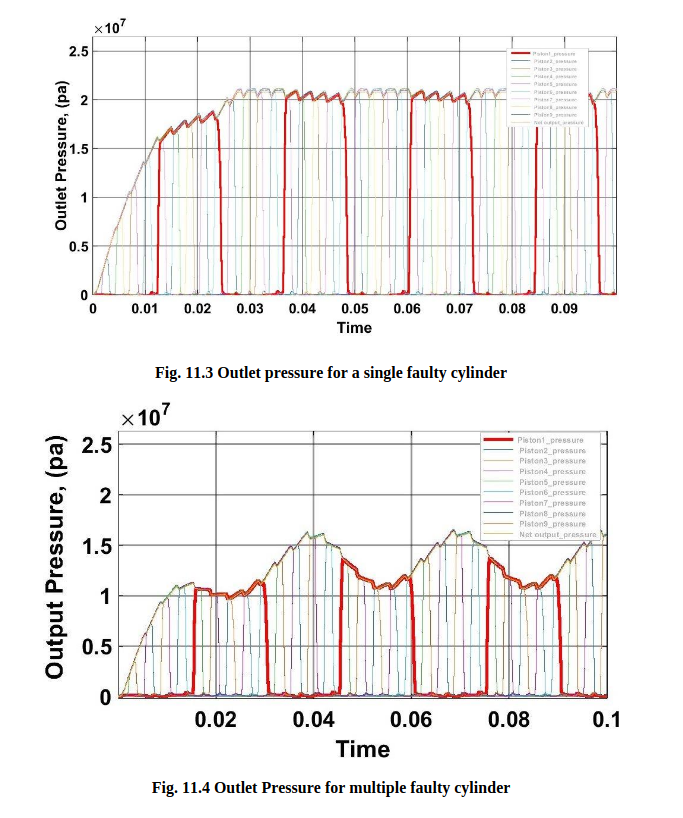
Identified three distinct stages of degradation in pressure signals as leakage severity increases
Increasing leakage reduced flow rate and disturbed outlet pressure with measurable patterns
Uniform piston arrangement produced the least pressure fluctuation in faulty systems
This research contributes valuable insights into optimizing the performance, reliability, and maintenance of axial piston pumps in practical settings. The findings on piston arrangement strategies provide a novel approach to managing pressure fluctuations in systems with leakage faults, potentially extending equipment life and reducing maintenance costs in industrial applications.
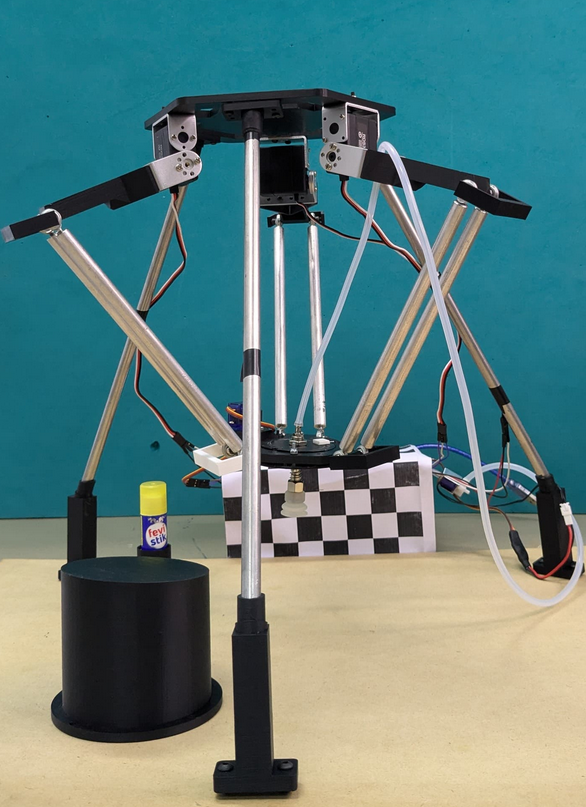
A delta robot with suction-based end effector designed for precise paper manipulation and assembly tasks, enabling automated crafting and paper-based construction.
I completed this project during my 1st semester's Mechatronics course at IIT Gandhinagar under the supervision of Prof. Madhu Vadali. SPAC-R is a specialized delta robot designed for precise paper manipulation and assembly. The robot utilizes a suction-based end effector to pick, place, and manipulate paper components with high precision, enabling automated crafting and paper-based construction tasks.
The development of SPAC-R involved designing a delta robot architecture optimized for paper manipulation, with a focus on precision movement and gentle handling through suction-based gripping.
Designed and 3D printed custom delta robot components optimized for paper handling
Developed a vacuum-based end effector with pressure feedback for delicate paper manipulation
Implemented inverse kinematics algorithms on Arduino for precise positioning
Created a Python-based control interface for path planning and operation
Achieves sub-millimeter positioning accuracy for detailed paper assembly tasks
Variable suction strength adjusts automatically to different paper weights and textures
Capable of performing up to 60 pick-and-place operations per minute
SPAC-R demonstrates significant potential for automating paper-based crafting and assembly tasks in educational settings, artistic applications, and small-scale manufacturing. The project contributes to the field of soft robotics by showcasing effective techniques for handling delicate materials with precision and care, while maintaining the speed advantages of delta robot architectures.
A dual-mode control strategy combining energy-based swing-up control with LQR stabilization, enhanced with state observers for robust performance in noisy environments.
This project presents a control strategy for an inverted pendulum on a cart, tackling the challenge of its inherent instability. The approach employs a dual-mode control system, combining an energy-based swing-up controller to bring the pendulum upright and a Linear Quadratic Regulator (LQR) for fine stabilization once it's near the desired vertical position.
The project involved developing a comprehensive control and state estimation strategy for the inverted pendulum system, addressing both the control challenges and real-world sensor limitations.
Derived nonlinear equations using Lagrangian mechanics and linearized around the upright position
Implemented energy-based swing-up control and LQR stabilization with smooth transition
Designed Luenberger observer and Kalman filter for state estimation from limited measurements
Conducted comparative analysis of observer performance under varying noise conditions
LQR gain matrix [185.16, 219.10, -7.81, 6.61] achieved optimal stabilization with minimal control effort
Energy-based swing-up successfully brought pendulum from downward to near-upright position
Kalman filter consistently outperformed Luenberger observer with up to 40% lower RMS error in noisy conditions
This research demonstrates a robust approach to controlling inherently unstable systems with limited sensor information, applicable to various domains including robotics, aerospace, and industrial automation. The findings on observer-based control provide valuable insights for implementing control systems in real-world noisy environments, potentially improving the reliability and performance of unstable mechanical systems.
Quantitative analysis of how human arm impedance adapts during drilling and screwing tasks under known versus unknown force perturbations, providing insights for human-robot collaborative systems.
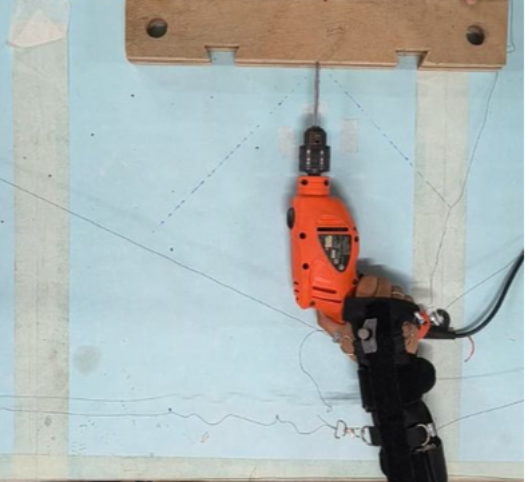
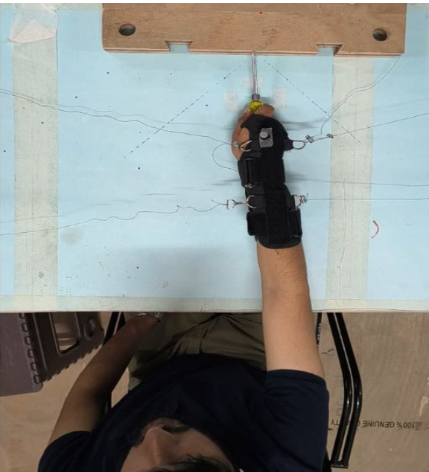
This academic project explores how human arm impedance adapts during drilling and screwing tasks when subjected to external force perturbations, comparing responses under known versus unknown perturbation conditions. By analyzing position and force data through a 2D second-order dynamic model, the study estimates mass, damping, and stiffness matrices for the arm.
The project involved a carefully designed experimental setup to measure and analyze human arm impedance during common manual tasks under different perturbation conditions.
Subject's wrist fixed to table with five strings attached to hand, routed through pulleys with weights
Subject performed drilling and screwing tasks while maintaining tool position despite perturbations
Vicon motion capture system recorded 3D position data of wrist and pulleys across 21 trials
Arm modeled as 2D second-order system with least squares regression to estimate parameters
Known force conditions resulted in higher, more targeted stiffness along the primary task axis (1.3x higher for drilling, 24% higher for screwing)
Dramatic differences in damping, with known force condition showing up to 152x higher damping in the primary screwing axis
Human arm exhibited natural asymmetry in stiffness, with higher stiffness in the dominant arm
Eta vector analysis revealed regions where all cables maintain positive tension for stable control
This research has significant implications for rehabilitation robotics, where cable-driven systems can provide controlled assistance over larger and more stable workspaces than human capabilities alone. The findings suggest that cable-driven manipulators with higher redundancy offer enhanced control precision and stability, potentially benefiting rehabilitation practices. However, careful regulation of motion range remains crucial for safe human-robot interaction in practical applications.
Comparative analysis of cable-driven manipulators with human arm workspace, demonstrating enhanced reach capabilities and stability with increased cable redundancy for rehabilitation applications.
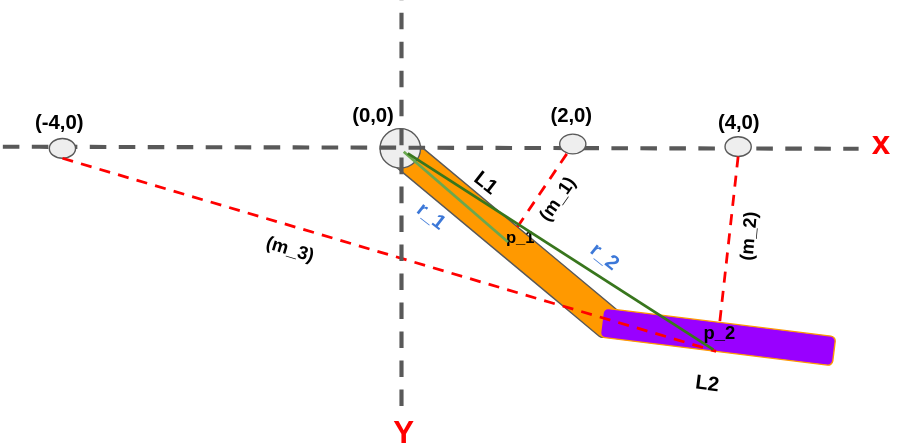
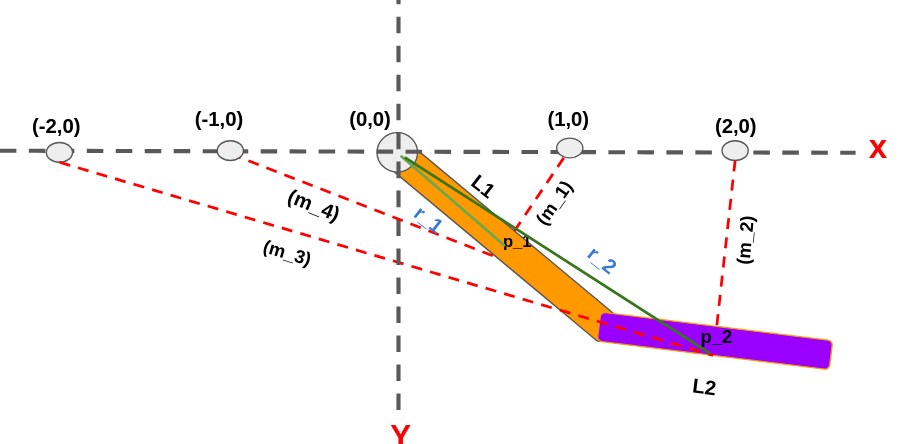
This project analyzes the workspace of a two-link planar manipulator actuated by cables, modeling an upper-extremity human limb. The study evaluates the reachable zone of the limb's end-point under different cable redundancy conditions and compares it with anatomically constrained human arm workspace.
The project involved a systematic approach to modeling and analyzing cable-driven manipulators in comparison with human arm workspace limitations.
Derived kinematic equations for the 2-link manipulator and defined cable attachment points
Formulated generalized structural matrices for 3-cable (m=n+1) and 4-cable (m=n+2) systems
Calculated null space vectors to identify feasible joint configurations where cables maintain tension
Mapped feasible joint configurations to task space and compared with human arm model
Cable-driven manipulators demonstrated broader range of motion than anatomically constrained human arm
4-cable system (m=n+2) showed improved stability and more uniform workspace distribution
Human arm workspace exhibited natural asymmetry due to physiological constraints
Eta vector analysis revealed regions where all cables maintain positive tension for stable control
This research has significant implications for rehabilitation robotics, where cable-driven systems can provide controlled assistance over larger and more stable workspaces than human capabilities alone. The findings suggest that cable-driven manipulators with higher redundancy offer enhanced control precision and stability, potentially benefiting rehabilitation practices. However, careful regulation of motion range remains crucial for safe human-robot interaction in practical applications.
Comprehensive biomechanical analysis of the overhead press exercise using musculoskeletal modeling to estimate joint kinematics, muscle forces, and joint torques for applications in rehabilitation, sports science, and human-robot interaction.
This project focuses on simulating and analyzing the biomechanics of a human overhead press exercise using musculoskeletal modeling tools. Understanding human movement biomechanics is crucial for various fields, including rehabilitation, sports science, ergonomics, and human-robot interaction. The study utilized OpenSim, a powerful software tool for simulating, analyzing, and visualizing internal dynamics such as joint kinematics, muscle forces, and joint torques, which are typically difficult to measure non-invasively.
The project employed a comprehensive approach to analyze the biomechanics of the overhead press using motion capture data and musculoskeletal modeling.
Captured motion data from subjects performing overhead press exercises with varying loads
Adapted generic musculoskeletal models to match subject-specific anthropometry
Calculated joint angles throughout the movement trajectory
Computed joint moments and forces required to produce the observed motion
Estimated individual muscle contributions and activation patterns
Deltoid and trapezius muscles showed highest activation during the concentric phase
Synchronized shoulder and elbow movement patterns optimized force generation
Increased trunk extension observed with heavier loads to maintain stability
Efficient energy transfer between joints reduced overall metabolic cost
This research contributes valuable insights into the biomechanics of overhead pressing movements, with applications in rehabilitation protocol design, sports performance optimization, and the development of assistive robotic devices. The detailed muscle force estimations and joint kinetics analysis provide a foundation for understanding injury mechanisms, optimizing training techniques, and designing more effective human-robot interaction systems that complement natural human movement patterns.
Implementation of a Cartesian impedance controller that enables compliant human-robot collaborative manipulation, allowing a robot to adaptively assist humans in lifting and placing tasks.
This project implements a Cartesian Impedance Controller for a robotic manipulator collaboratively lifting and placing a box with a human partner. The robot operates in task space (Cartesian space) and exhibits compliant, human-friendly behavior.
The end-effector is modeled as a mass-spring-damper system in 3D space, allowing the robot to follow smooth position and orientation trajectories while adapting compliantly to external forces — ideal for human-robot interaction tasks.
Computes forward kinematics for pose tracking, Jacobian for mapping Cartesian forces to joint torques, and updates pose and velocity in real-time
Uses quintic polynomial interpolation for position and SLERP for orientation, ensuring smooth acceleration/deceleration with zero start/end velocity
Sequences through initialize, lift, and place poses with a 15-second interpolation per pose, maintaining final position with impedance control
Runs at 500 Hz, continuously computing Cartesian errors and applying impedance torques via Jacobian transpose
Enables safe and compliant co-manipulation with a human lifting the other side of the box
Quintic polynomial interpolation ensures jerk-free motion with p(t) = a₀ + a₁t + a₂t² + a₃t³ + a₄t⁴ + a₅t⁵
Automatically adjusts to external disturbances or human corrections during the task
Avoids excessive joint forces through natural impedance-based compliance
This Cartesian impedance control strategy demonstrates significant potential for collaborative robotics applications, particularly in manufacturing, logistics, and assistive scenarios. The controller's ability to maintain precise positioning while adapting to human input makes it ideal for co-manipulation tasks, physical human-robot interaction (pHRI), and assistive lifting operations. The implementation provides a foundation for developing more sophisticated collaborative behaviors that can enhance productivity and safety in human-robot workspaces.
Implementation of a joint-space impedance controller with velocity-based trajectory planning that ensures compliant, smooth, and velocity-safe motion for robotic manipulation tasks.
This project implements joint-space impedance control with PID gains and quintic trajectory generation for the Heal Robot. The controller computes joint torques based on position, velocity, and integral errors, ensuring compliant and smooth motion. The implementation supports effort (torque) control, is designed for ROS, and integrates trajectory planning based on maximum time and velocity.
The controller uses a PID torque control structure enhanced with impedance behavior, combined with velocity-based trajectory planning for safe and efficient motion.
Carefully tuned gains (Kp: [148, 140, 130, 120, 115, 130], Kd: [57, 52, 45, 50, 40, 45], Ki: [65, 60, 60, 60, 55, 60]) for optimal performance across all joints
Computes torque as τ = Kp × e_pos + Kd × e_vel + Ki × ∫ e_pos dt with integral clamping to prevent windup
Calculates trajectory duration based on joint distances and maximum allowable velocities, ensuring no joint exceeds its speed limit
Generates smooth paths using 5th-order polynomials: q(t) = a₀ + a₁t + a₂t² + a₃t³ + a₄t⁴ + a₅t⁵ with zero initial/final velocities and accelerations
Computes trajectory time based on per-joint distance and maximum velocity constraints
Quintic polynomial ensures jerk-free transitions with continuous acceleration profiles
Enforces velocity limits and implements anti-windup strategy for integral term
Control loop runs at 500 Hz with target-aware tracking and termination on convergence
This joint impedance control implementation provides a robust foundation for precise and compliant robot manipulation tasks. The velocity-based trajectory planning approach ensures safe operation while maintaining optimal performance. The system is particularly valuable for applications requiring careful motion control, such as assembly tasks, human-robot collaboration, and manipulation in constrained environments. The controller's ability to balance between position accuracy and compliance makes it suitable for a wide range of robotic applications.
Implementation of an admittance control strategy using force-torque sensor feedback to enable intuitive physical human-robot interaction, allowing the robot to respond naturally to applied forces.
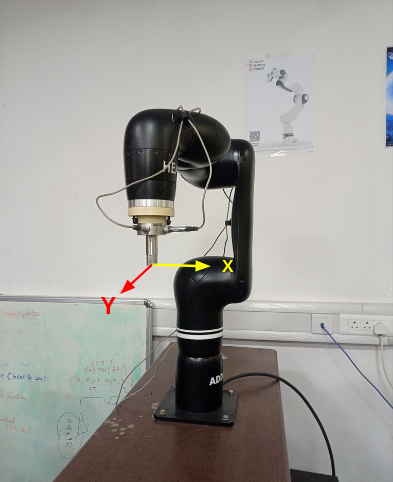
This project implements admittance control on a custom 6-DOF Heal robot with a biaxial FUTEK force-torque (FT) sensor mounted on the end-effector. The sensor measures forces in the X and Y directions, which are then used to command motion through an admittance control strategy in Cartesian space.
The admittance control strategy maps measured forces to robot motion using a quasi-static approximation of the system dynamics.
Based on the fundamental equation: M·Δẍ + Kd·Δẋ + he = h, where M is the mass matrix, Kd is the damping matrix, he is the end-effector wrench, and h is the desired wrench
Neglects inertial effects to derive the control law: ẋr = ẋd + Kd⁻¹(he - h), mapping measured forces to reference velocities
Uses the robot Jacobian to convert Cartesian velocities to joint velocities: q̇r = q̇d + J⁻¹[Kd⁻¹(he - h)]
Processes real-time force measurements from the biaxial FUTEK FT sensor to enable responsive control in both X and Y directions
Supports both 1D (Y-axis only) and 2D (X-Y plane) admittance control modes
Direct mapping of measured forces to Cartesian velocities with tunable damping parameters
Enables natural physical guidance of the robot through direct hand contact
Tunable damping values allow for customizing the robot's responsiveness to applied forces
This admittance control implementation enables intuitive physical human-robot interaction, making it valuable for collaborative tasks, teaching by demonstration, and assistive applications. The system allows users to guide the robot naturally by applying forces directly to the end-effector, creating a more accessible interface for non-expert users. This approach has significant potential in manufacturing, healthcare, and service robotics where direct physical interaction between humans and robots is beneficial.
Implementation of object-level admittance control for coordinated dual-arm manipulation, enabling compliant and adaptive object handling in response to external forces.
This project implements object admittance control for a dual-arm robotic system in a MuJoCo simulation. The robot collaboratively lifts an object (like a box) using sensor feedback, dynamic control, and intelligent coordination between both arms.
The object admittance control strategy enables compliant interaction with the environment by responding to external forces detected through both robot arms.
Based on the equation: ẋₒ* = ẋₒ + D⁻¹(W - W* - K(xₒ* - xₒ)), where D is the damping matrix, K is the stiffness matrix, and W represents the sensed wrench
Detects contact between robot and box, extracting forces & torques (wrenches) from both arms for feedback control
Converts Cartesian object velocity to joint velocity using Jacobians of both arms with safety velocity limits
Manages transitions between reaching, grasping, lifting, and maintaining states based on robot progress and sensor feedback
Combines control of two robot arms to stably grasp and move objects with coordinated motion
Adjusts lifting motion based on sensed wrenches from both arms for adaptive object handling
Implements intelligent recovery strategies when contact is lost or force thresholds are not met
Leverages accurate physics-based simulation for realistic testing of control algorithms
This object admittance control implementation demonstrates significant potential for collaborative robotic manipulation tasks. By enabling compliant and adaptive object handling, the system can be applied to various scenarios including manufacturing assembly, logistics, healthcare assistance, and household tasks. The dual-arm coordination with force feedback creates more robust manipulation capabilities that can adapt to object variations and environmental uncertainties, advancing the field of physical human-robot interaction and collaborative robotics.
Implementation of progressive control strategies from basic gravity compensation to full impedance control on a 2R manipulator, enabling compliant and adaptive interaction with the environment.
In our 2R manipulator simulation using MuJoCo, we implemented and explored various control strategies to achieve stable and responsive joint behavior. The project demonstrates the evolution of control approaches from basic compensation to interactive impedance control.
Our research explored a progression of control approaches, starting with basic gravity compensation and advancing toward full impedance control for interactive tasks.
Calculated and applied torques at each joint to counteract gravity effects, enabling the manipulator to maintain static configurations without collapsing
Implemented Proportional-Derivative control with desired joint positions, computing control torques based on position and velocity errors
Combined gravity compensation and PD control to emulate a mass-spring-damper system, allowing compliant response to external forces
Validated control strategies in MuJoCo environment with various initial conditions and external disturbances
Gravity compensation successfully maintained static configurations (e.g., 45° and 60° for joints 1 and 2) without collapsing
PD control enabled smooth convergence to target configurations from arbitrary initial states
Impedance control framework demonstrated potential for human-robot interaction and adaptive object manipulation
The simulation provides a foundation for integrating advanced behaviors like surface contact maintenance and constrained path following
This research establishes a foundation for more advanced robot control applications. In future extensions, impedance control will allow the 2R arm to maintain contact with surfaces, guide objects along constrained paths, or adaptively respond to perturbations rather than rigidly fighting against them. The framework developed here serves as a stepping stone toward more sophisticated human-robot interaction scenarios and compliant manipulation tasks.